
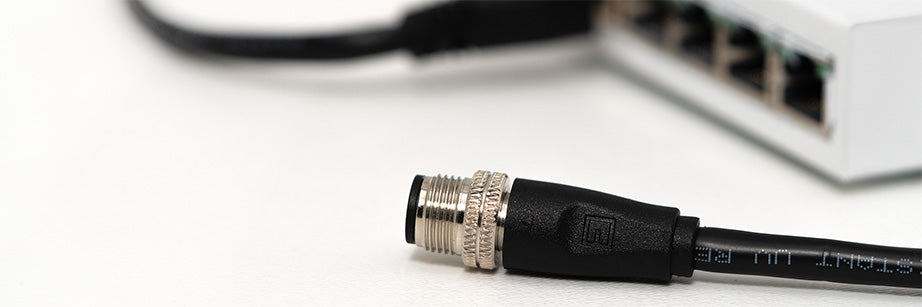
M12 D-code Ethernet cable assemblies are designed for industrial communication systems where secure connections and consistent performance are required. The D-code keying structure is standardized for 4-pin Industrial Ethernet (10/100 Mbps) applications and features threaded coupling to help maintain connection integrity in demanding environments.
These assemblies utilize Cat5e cable with a two-pair (2PR) 24 AWG construction, supporting reliable data transmission up to 1 Gbps. The Cat5e specification ensures controlled impedance and consistent signal performance, while shielding helps reduce electromagnetic interference (EMI) in electrically noisy environments.
Cable options include both PVC and TPU jacket materials to support a range of installation requirements. PVC jackets provide a cost-effective solution for general-purpose indoor applications, while TPU options offer enhanced flexibility and durability in more demanding environments. TPU constructions are UL21765 recognized, supporting applications that require higher mechanical performance and resistance characteristics.
Designed for industrial use, these assemblies support 48 V systems with current ratings up to 1.5 A and operate across a -40 to 105 °C temperature range. The cable construction also supports resistance to oil, water, and UV exposure, making it suitable for use in harsh environments.
An IP67 rating is achieved when mated with a corresponding M12 connector, helping protect against dust and water ingress in industrial installations. Consistent connector geometry across the product line supports integration into both new designs and existing systems.
SEE ALL PRODUCT
Key Features |
Applications |
|
|
FAQs
Why use M12 D-code connectors for Ethernet?
M12 D-code connectors are standardized for 4-pin Industrial Ethernet. The keyed interface ensures proper mating, while threaded coupling maintains a secure connection in vibration-prone environments.
What is the benefit of two-pair Cat5e construction?
Two-pair construction reduces cable diameter, making routing easier in tight spaces while still supporting reliable 10/100 Mbps Ethernet communication.
Why is shielding important in industrial environments?
Shielding reduces electromagnetic interference from nearby equipment such as motors and drives, improving signal integrity and communication reliability. What does UL 20387 compliance provide? UL 20387 compliance ensures the cable jacket resists UV exposure, moisture, and oils, making it suitable for outdoor and harsh industrial environments.