
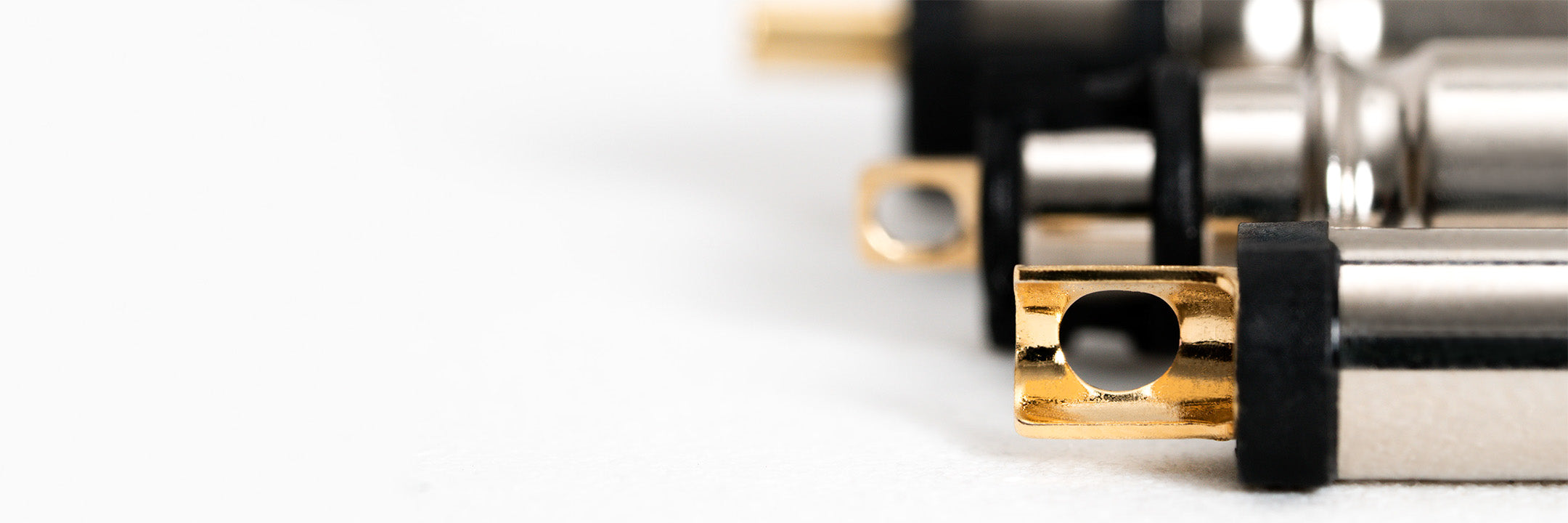
Tensility’s high-current dc connector series expands the company’s power connector lineup with robust solutions designed for demanding power applications. The series includes three mating pairs of PCB dc jacks and inline plugs available in 5.5 × 2.5 mm, 7.4 × 5.1 mm, and 7.9 × 5.6 mm form factors.
These connectors support 48 V systems and deliver current ratings up to 20 A, enabling reliable power delivery for higher-load devices and equipment. Gold-plated contacts reduce contact resistance while resisting oxidation, helping maintain stable electrical performance over repeated mating cycles.
Constructed with high-temperature thermoplastic insulation materials including PBT and LCP, the connectors are engineered to operate in demanding environments. This material selection allows the plugs to operate from −40 °C to +150 °C and the jacks from −40 °C to +200 °C while maintaining mechanical integrity and electrical stability. With a durability rating of up to 5,000 mating cycles, these connectors provide long-term reliability in high-current power applications.
SEE ALL PRODUCT
Key Features |
Applications |
|
|
FAQ
Why are gold-plated contacts important in power connectors?
Gold plating improves the reliability of electrical connectors by reducing contact resistance and preventing surface oxidation. Unlike many other metals, gold does not easily corrode, which helps maintain a consistent electrical interface over time.
For power connectors carrying higher current levels, stable contact resistance is critical. Gold-plated contacts help maintain reliable conductivity across repeated insertions.
Why are PBT and LCP used for connector insulation?
Connector insulation materials must maintain electrical isolation, mechanical strength, and dimensional stability under both electrical load and environmental heat.
- PBT (polybutylene terephthalate) — a polyester-based thermoplastic known for its dimensional stability, electrical insulation properties, and resistance to heat and chemical exposure. PBT is widely used in power connectors because it maintains structural integrity under sustained electrical load.
- LCP (liquid crystal polymer) — an advanced polymer with exceptionally high heat resistance, low moisture absorption, and excellent creep resistance. LCP is often selected for connectors operating in high-temperature environments because it maintains tight mechanical tolerances even under prolonged thermal stress.
Compared with lower-temperature plastics such as standard nylon or general-purpose thermoplastics, these materials provide higher thermal stability, improved dielectric strength, and better long-term dimensional stability, allowing connectors to safely support higher current loads and extended operating temperatures.
What wire gauge should be used with high-current dc connectors?
For applications approaching the maximum current rating of these connectors, 16 AWG wire or larger is recommended. Using an appropriately sized conductor helps reduce voltage drop and prevents excessive heat buildup within the cable.
Different insulation materials can affect the current-carrying capability of a wire, so it is important to consult a current carrying capacity chart when selecting wire for high-current applications.
Where can I find PCB layout resources for the panel-mount dc jacks?
Tensility provides free PCB layout templates through SnapMagic for the panel-mount dc jacks in this series. These files are available in multiple formats and can help streamline board design and connector integration during product development.