
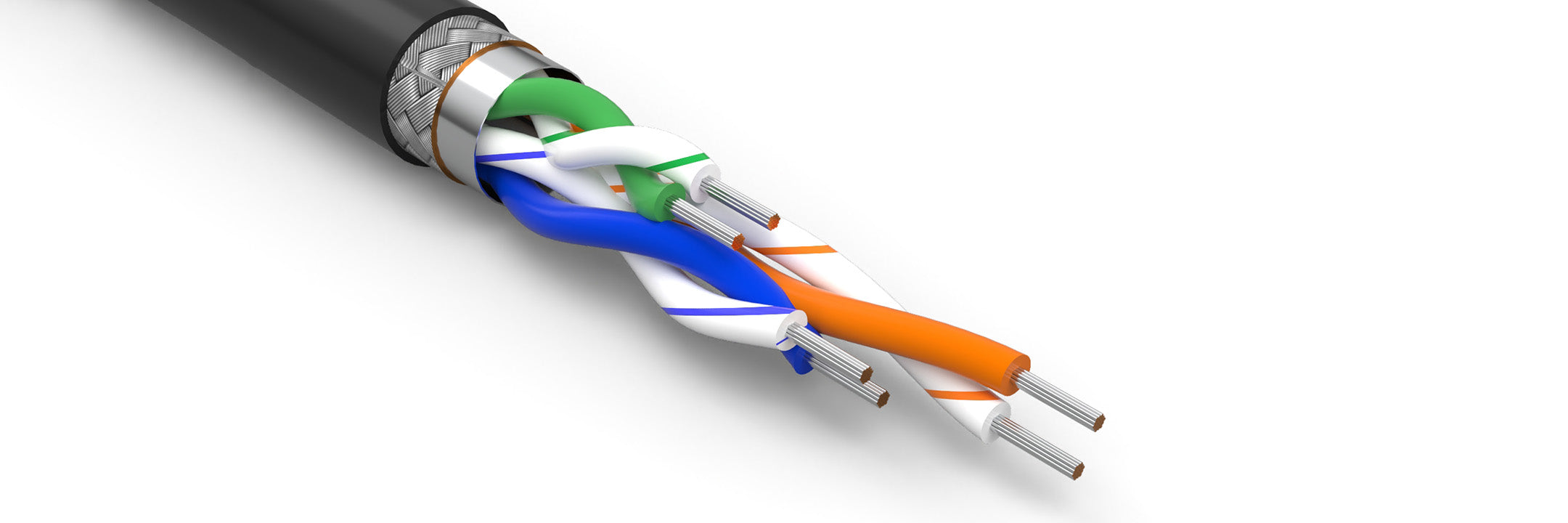
Shielded CMP communication wire is designed for signal and power transmission in plenum environments where low smoke, flame rated cable construction is required. Power and multi-pair wire provides flexibility for communication and control systems in demanding installations.
CMP represents the highest fire safety classification for communication cable, verified through standardized testing such as NFPA 262 (Steiner Tunnel). This rating ensures strict limits on flame propagation and smoke generation, making CMP cable suitable for use in plenum spaces and other air-handling environments where building codes require elevated fire performance.
The construction includes FEP insulated conductors with aluminum foil shielding and a tinned copper braid providing full shielded coverage under a PVC outer jacket. This combination supports consistent signal integrity while maintaining the flame and smoke performance required for plenum installations.
The following tables highlight the available conductor pair and gauge combinations for both same gauge and mixed gauge constructions. Same gauge designs maintain a consistent conductor size across all twisted pairs, while mixed gauge configurations combine larger power conductors with smaller signal conductors to support applications requiring both power delivery and data or control transmission within a single cable assembly.
Same Gauge Wires
| Number of Twisted Pairs | Gauge Size (AWG) |
|---|---|
| 1 PR | 20, 22, 24, 26 |
| 2 PR | 20, 22, 24, 26 |
| 3 PR | 20, 22, 24, 26 |
| 4 PR | 20, 22, 24, 26 |
Mixed Gauge Wires
| Signal Pair Gauge Size | Power Pair Gauge Size |
|---|---|
| 20 AWG | 18 AWG |
| 22 AWG | 18 AWG |
| 24 AWG | 22 AWG |
| 28 AWG | 22 AWG |
Key Features |
Applications |
|
|
FAQs
What does CMP stand for?
CMP stands for Communications Multipurpose Plenum. It identifies cable designed for plenum spaces where strict flame and smoke requirements apply.
What is the difference between CMP, CMR, and CM(G) ratings?
CM or CMG (general) is a general rating for in-wall cables that can be used in residential or commercial use cases. CMR (riser) cables have a higher flame resistance that allows them to be used in vertical shafts but are not allowed in plenums. CMP is the highest rating of communications cable jacket ratings with regards to fire resistance and low smoke properties. A CMP cable may be used in applications that call for a CM(G) or CMR cable rating but only CMP cables may be used in plenum spaces.
Why choose CMP plenum cable?
CMP cable is used when installations run through plenum spaces or when required by building code or project specifications. The selection is typically driven by installation environment rather than electrical performance alone.
What is a plenum space?
A plenum is an air-handling space, such as above ceilings or below raised floors, used for air circulation. Cables in these areas must meet stricter fire and smoke standards.
What is impedance and why does it matter?
Impedance defines how a cable resists alternating current at higher frequencies. Matching impedance to system requirements helps maintain signal integrity and reliable communication.
What is the difference between static and dynamic temperature ratings?
Static ratings apply to fixed installations while dynamic ratings apply to cables that flex during use. Dynamic ratings are typically more restrictive due to mechanical stress.
Why use both foil and braid shielding?
Foil shielding provides high-frequency EMI protection with zero gap coverage. A braided shield adds mechanical strength and improves low-frequency shielding. Together, they create a robust shielding system.